Marketing has changed fast. A few years ago, businesses relied heavily on manual campaigns, spreadsheets, and trial-and-error strategies. Today, many companies are quietly paying for AI marketing automation tools to save time, reduce costs, and get better results with less effort.
This doesn’t mean AI replaces marketers. Instead, it helps businesses automate repetitive tasks, analyze data faster, and make smarter decisions. In this article, you’ll see what AI marketing automation really is, why businesses are investing in it, and the tools companies are actually using right now.
What Is AI Marketing Automation?
AI marketing automation refers to software that uses artificial intelligence to manage, optimize, and automate marketing activities. These tools can handle tasks like email campaigns, customer segmentation, ad optimization, lead scoring, and content suggestions.
Unlike traditional automation tools that follow fixed rules, AI-powered tools learn from data. Over time, they can predict customer behavior, personalize messages, and improve performance without constant manual input.
Why Businesses Are Paying for AI Marketing Automation Tools
Businesses don’t pay for tools unless they see value. Here’s why many companies now rely on AI-powered marketing software:
-
Time savings: AI automates repetitive tasks like scheduling emails and analyzing reports.
-
Better targeting: AI tools analyze user behavior to reach the right audience.
-
Higher conversions: Personalized messaging often leads to better engagement.
-
Lower marketing costs: Automation reduces the need for large marketing teams.
-
Scalability: Campaigns can grow without increasing workload.
For both small businesses and large companies, these benefits make AI marketing automation worth the investment.
Types of AI Marketing Automation Tools Businesses Use
AI marketing automation tools come in different forms, depending on the marketing task.
Email Marketing Automation
These tools personalize email campaigns, optimize send times, and segment audiences automatically.
Customer Relationship Management (CRM)
AI-powered CRMs help businesses track leads, predict customer behavior, and improve follow-ups.
Social Media Automation
AI tools schedule posts, analyze engagement, and recommend content that performs better.
Advertising & Campaign Optimization
These platforms optimize ads by adjusting bids, targeting, and creatives based on performance data.
Content & SEO Tools
AI assists with keyword research, content optimization, and performance tracking.
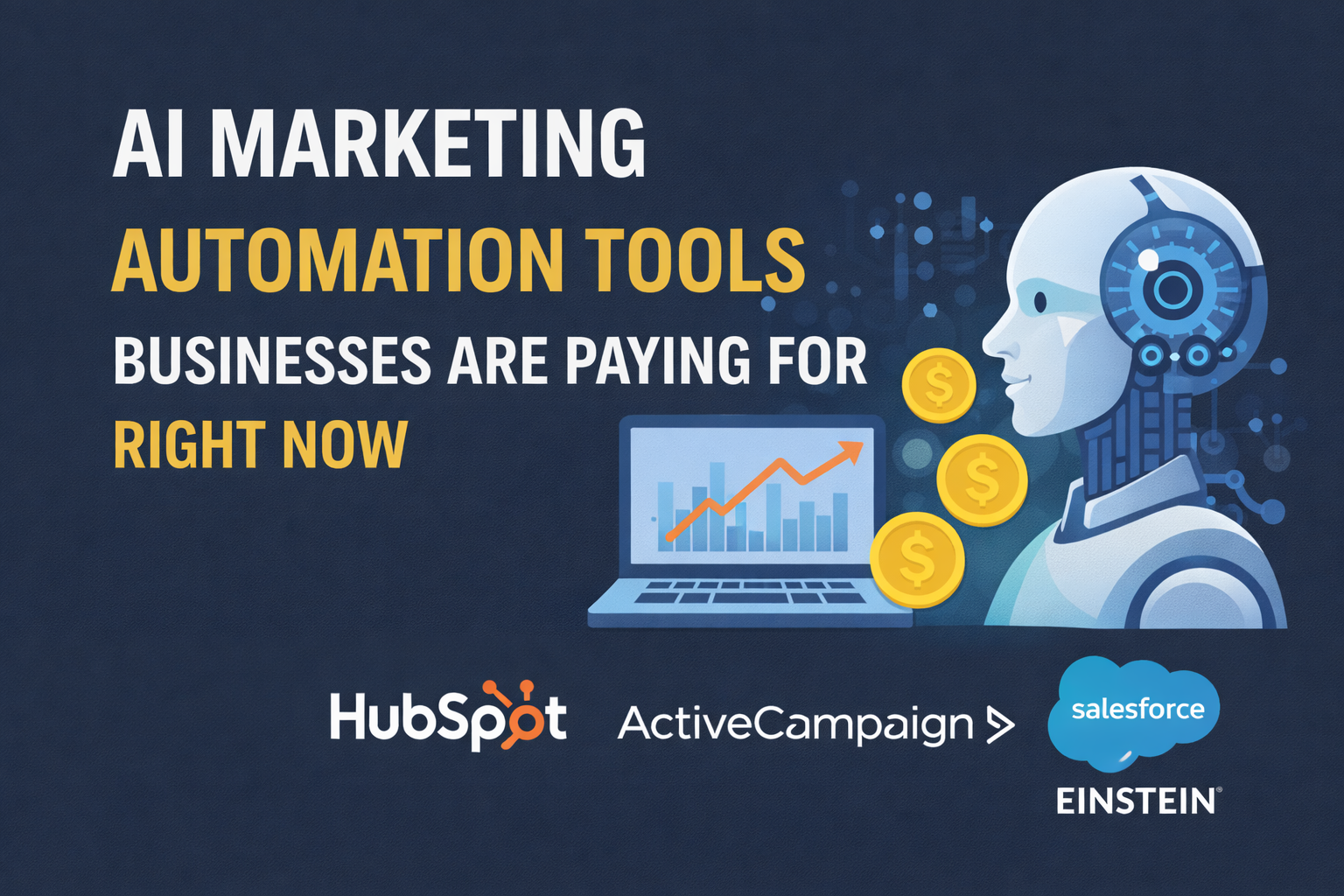
Popular AI Marketing Automation Tools Businesses Are Paying For
Here are some widely used AI marketing automation tools across different industries:
-
HubSpot AI – Used for email marketing, CRM, and lead automation.
-
ActiveCampaign – Popular for AI-driven email and customer journeys.
-
Mailchimp AI – Helps businesses automate campaigns and predict engagement.
-
Salesforce Einstein – Advanced AI tools for enterprise-level marketing and CRM.
-
Semrush AI – Used for SEO, content optimization, and competitive research.
-
Jasper AI – Assists with AI-powered content creation.
-
Hootsuite AI & Buffer AI – Used for social media scheduling and analytics.
-
Zapier AI – Connects and automates workflows between different marketing tools.
These are tools businesses actively pay for because they deliver measurable improvements in efficiency and performance.
How Businesses Use AI Marketing Automation in Real Life
In real-world scenarios, businesses use AI marketing tools to:
-
Automate email sequences for new leads
-
Score and prioritize potential customers
-
Personalize product recommendations
-
Optimize ad campaigns based on real-time data
-
Track and improve customer journeys
The goal is not full automation but smarter marketing with less manual effort.
AI Marketing Automation for Small Businesses vs Large Companies
Small businesses often use affordable or freemium AI tools to manage limited resources. Larger companies invest in enterprise-level platforms with advanced analytics and integrations.
The good news is that many AI marketing automation tools now offer flexible pricing, making them accessible to startups and solo marketers as well.
How to Choose the Right AI Marketing Automation Tool
Before paying for any tool, businesses usually consider:
-
Ease of use
-
Pricing and scalability
-
Integration with existing tools
-
Data privacy and compliance
-
Quality of analytics and reporting
Starting with a free trial helps test whether a tool fits your needs.
Conclusion
AI marketing automation tools are no longer optional for many businesses. They help companies work faster, reach customers more effectively, and make data-driven decisions. While these tools require learning and testing, they can significantly improve marketing performance when used correctly.
As AI continues to evolve, businesses that understand and adopt these tools early are often better positioned to compete in today’s digital market.